Riding with the legends
From the first Tour over the Galibier in 1911 to the Angliru in 1999: why the great climbs feel different.
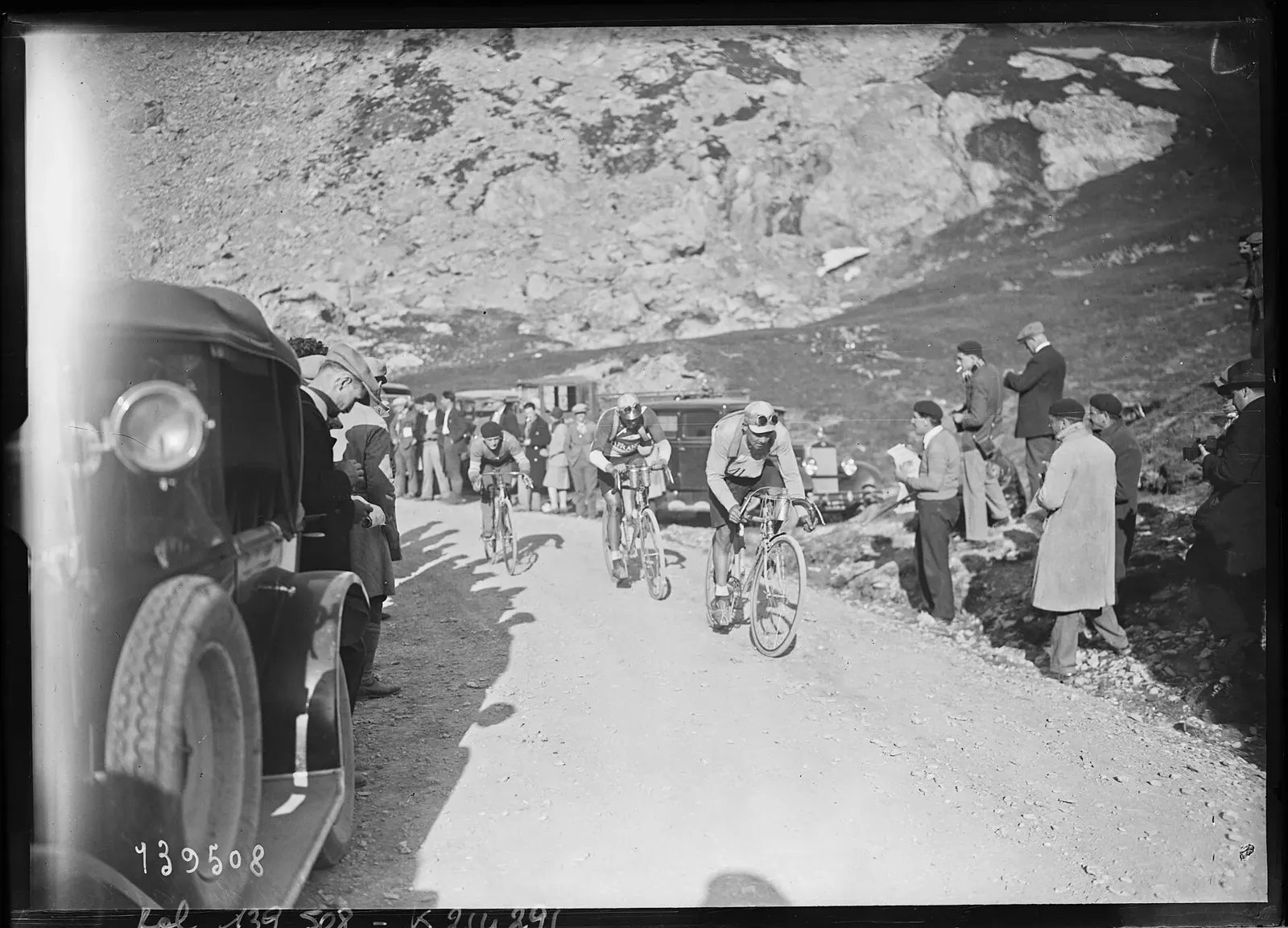
Photo: Agence Rol (via Gallica / BnF) · Public domain
A climb is just a road until somebody suffers on it in front of the world. Then it becomes a place people travel to – to ride the same hairpins, read the names painted on the tarmac and find out, a few kilometres from the top, what all the fuss was about.
The Tour de France went into the Pyrenees in 1910 and over the Galibier a year later. The Giro first crossed the Stelvio in 1953, and the Vuelta found its modern monuments in Asturias: the Lakes of Covadonga in 1983 and the Angliru in 1999. Here is what our sources record for each climb in the Atlas – with links, so you can check.
Etna – Rifugio Sapienza 🇮🇹
- Giro d'Italia: Rifugio Sapienza was the finish of stage 9 in 2011 and stage 4 in 2017 (Wikipedia).
Passo dello Stelvio 🇮🇹
- Giro d'Italia: first crossed in 1953, when Fausto Coppi beat Hugo Koblet (Wikipedia).
Passo del Mortirolo 🇮🇹
- Giro d'Italia: first used on stage 15 of the 1990 Giro, climbed from Edolo (Wikipedia).
- Since 2004 the first rider over the top in the Giro takes the ‘Cima Pantani’ prize (Wikipedia).
Passo di Gavia 🇮🇹
- Giro d'Italia: often on the route and sometimes the Cima Coppi, the race's highest point; Wikipedia lists appearances since 1960.
- 5 June 1988: the race crossed the Gavia in a snowstorm; Erik Breukink won the stage and Andrew Hampsten took the lead and went on to win the Giro (Wikipedia).
Mont Ventoux 🇫🇷
- Tour de France: ascended eighteen times since 1951, per Wikipedia at retrieval.
Alpe d'Huez 🇫🇷
- Tour de France: first included in 1952, won by Fausto Coppi; a regular stage finish since 1976 (Wikipedia).
Col de la Madeleine 🇫🇷
- Tour de France: first included in 1969; featured 28 times per Wikipedia at retrieval.
Col du Galibier 🇫🇷
- Tour de France: first used in 1911; Emile Georget was first over the summit (Wikipedia).
- 2011: first-ever summit finish, won by Andy Schleck after a 60 km solo breakaway (Wikipedia).
Pas de Peyrol (Puy Mary) 🇫🇷
- Tour de France: first used in 1959 on a stage from Aurillac to Clermont-Ferrand (Wikipedia).
- 2020: stage 13 finished at the summit, won by Daniel Martínez (Wikipedia).
Col du Tourmalet 🇫🇷
- Tour de France: included more than any other pass, starting in 1910 (Wikipedia).
- 2023: first included in the Tour de France Femmes, as its queen stage (Wikipedia).
Lagos de Covadonga 🇪🇸
- Vuelta a España: first featured in 1983, won by Marino Lejarreta during his battle with Bernard Hinault (Wikipedia).
- Called, together with the Angliru, the most important climb in the modern history of the Vuelta (Wikipedia).
Alto de l'Angliru 🇪🇸
- Vuelta a España: first included in 1999, on stage eight from León (Wikipedia).
Calar Alto 🇪🇸
- Vuelta a España: stage finishes at the observatory in 2004 (Roberto Heras), 2006 (Igor Antón) and 2017 (Miguel Ángel López) (Wikipedia).
Data Race facts are quoted from the Wikipedia articles linked on each climb page (retrieved 14 Nov 2026). Official race results and unofficial ‘fastest times’ are different things – we only show the former.